
The steel industry is the backbone of the Indian economy, contributing to 2% GDP. [1] Though a growth catalyst, the industry contributes to 10-12% of the country’s total carbon emissions. There is a need to balance progress with the efforts of climate action. With a production target of 500 million tonnes by 2047, the decarbonisation of steel becomes imperative. [2]
One promising pathway is the production of green steel. Although it currently carries a premium, green steel production technologies can significantly reduce emissions. Traditional steelmaking, BF-BOF (Blast furnace - Basic Oxygen Furnace), emits 2.68 tCO₂/tcs. Switching to a green hydrogen-based DRI-EAF method can lower the emissions to 2.13 tCO₂/tcs. [3] Thus, green steel production methods have potential for development without environmental harm.
In this blog, we explore the challenges and potential solutions of sustainable steelmaking.
Steel powers industries worldwide, but it also releases heavy carbon emissions. In 2020, total carbon emissions from the steel sector were 2.6 billion tonnes. Traditional steelmaking relies on coal, releasing vast amounts of CO₂. Green steel production offers an alternative. It uses green hydrogen, renewable energy, and advanced processes to replace coal. This shift can cut emissions and make steel more sustainable.
The green steel industry will grow from $7.4 billion in 2024 to $19.4 billion by 2029 with a 21.4% CAGR. [4] Major sectors, such as automotive and construction, are committing to sustainable procurement. As India ramps up production to meet growing demand, the environmental impact could be enormous.
Beyond climate concerns, global market dynamics are pushing steelmakers toward decarbonization. The EU’s Carbon Border Adjustment Mechanism (CBAM), starting in January 2026, penalises imports based on carbon intensity.CBAM could raise Indian steel export costs by up to 25%. High-emission steel may face duties of ~€174/t ($180–250/t), eroding competitiveness in the EU.[5]
These pressures underscore the importance of green steel production methods. These technologies lower carbon intensity, improve competitiveness in carbon-sensitive markets, and position steelmakers to meet global climate targets.
The greenness of the steel is expressed as a percentage of CO₂ emissions produced by the steel plant in comparison to the 2.2 tonnes of CO₂eq per tonne of finished steel (tfs) threshold. Carbon dioxide emissions from a plant will determine the grade of green steel:
| Green Steel Grade | Emission intensity |
|---|---|
| Five-star rating | Lower than 1.6 t-CO₂eq/tfs |
| Four-star rating | Between 1.6 and 2.0 tCO₂eq/tfs |
| Three-star rating | Between 2.0 and 2.2 tCO₂eq/tfs |
| No green rating | Higher than 2.2 tCO₂eq/tfs |
Green hydrogen reduces iron ore pellets to Direct-Reduced Iron (DRI) in a shaft furnace. The Electric Arc Furnace (EAF) then melts the DRI. Pelletizing boosts ore quality but increases costs.
JSW Steel is building a 25 MW green hydrogen project in Vijayanagar, Karnataka. It's the first green hydrogen steelmaking initiative in India.[6]
POSCO, South Korea’s leading steelmaker, produces 2.05 tons of carbon emissions per 1 ton of finished steel. It is decarbonising steel through HyREX technology, its hydrogen- and natural gas-based direct reduced iron process. POSCO and Primetals Technologies will develop a 300,000-ton-per-year pilot project at the Pohang plant after 2030. POSCO is expanding green steel at Gwangyang with a 2.5 million-ton-per-year EAF; construction started in 2024 at $450 million.[7]
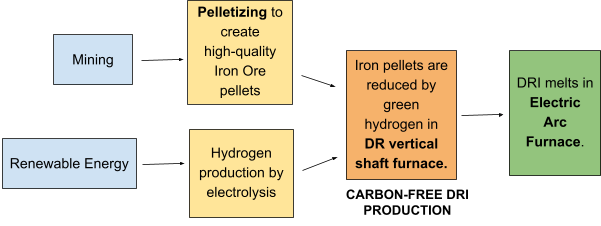
Schematic diagram of DRI-EAF green steel production
High-temperature green hydrogen gas fluidises and reduces iron fines in multi-stage reactors. Green steelmaking continues in an electric arc furnace (EAF). Fluidised bed technologies can use iron ore fines, eliminating the need for pelletizing. This reduces cost, but scaling remains a challenge.
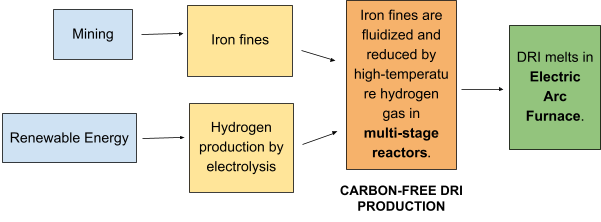
Schematic diagram of Fluidised Bed H₂-DRI-EAF green steel production
HSPR technology produces molten iron by reducing iron ore with hydrogen plasma in a reactor. It reduces hydrogen use, improves process efficiency, and eliminates the need for an electric arc furnace. However, it is still in its nascent stage.
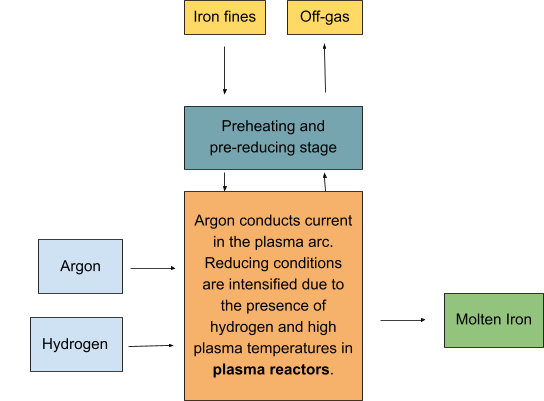
Schematic diagram of Hydrogen Smelting Plasma Reduction
Electrolysis of iron ore happens through:
Electric ironmaking avoids hydrogen use and can integrate with existing steel mills. But it needs time to scale and become cost-effective.

This green steel production process produces about 20% carbon in comparison to the conventional method. Ship recycling has the potential to contribute up to 10 million tonnes of high-grade scrap steel by 2030.
Swedish speciality steel maker, SSAB, is known for its HYBRIT technology for fossil-free steelmaking. It has begun construction of its new green steel mill in Luleå. The mill will have two electric arc furnaces. It will use fossil-free sponge iron and recycled scrap for sustainable steel production.[8]
Comparison of CO₂ emissions intensity (tonnes CO₂ per tonne of crude steel cast)
| Steel production method | CO₂ emissions intensity |
|---|---|
| BF-BOF | 2.32 |
| DRI-EAF | 1.43 |
| Scrap-EAF | 0.7 |
Source: World Steel Association [9]
The Indian government may mandate the use of green steel in public infrastructure starting in 2028.
Green steel production can decarbonise the industry and meet global climate objectives. Scaling up decarbonising technologies, such as hydrogen-based DRI, plasma reduction, and electric ironmaking, is challenging. The National Green Steel Mission and JSW’s green steelmaking initiative signal strong momentum.
As green steel production scales, it will reshape global trade, supply chains, and industrial growth. The next decade will determine whether India leads this transformation or risks falling behind. The opportunity is clear; what matters now is the pace and resolve of action.
Sources:
